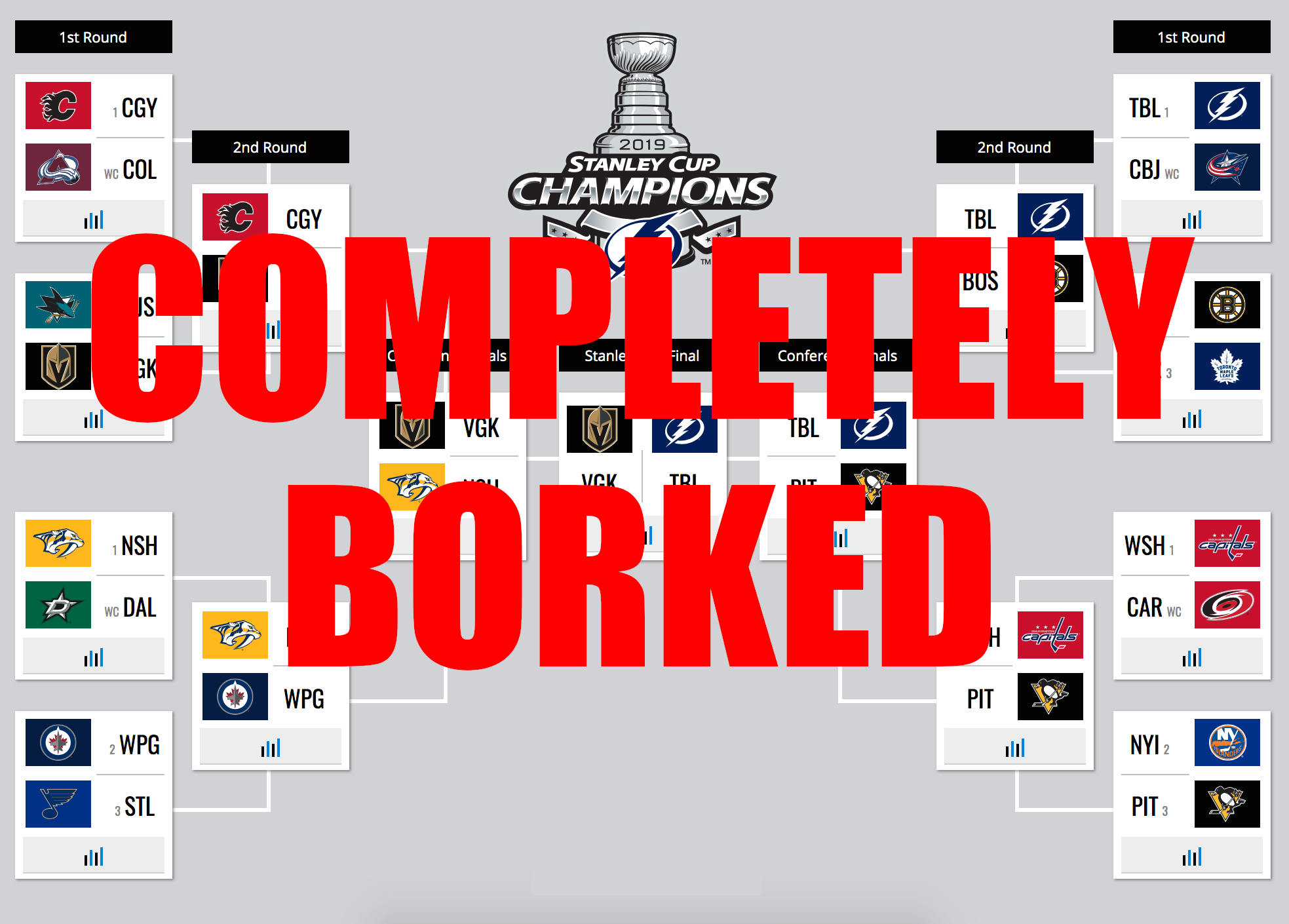
Look at that. Look at that complete disaster of a playoff bracket. This is why I don’t bet on sports.
I am not a hockey expert. But I’ve been watching the game for a while so I’d like to think I know a thing or two about it. Apparently that does not apply to this year’s NHL playoffs, because I just went one for eight in my predictions for the first round. ONE FOR EIGHT. Are you kidding me? I would have done better flipping a coin! Now, in my defence, something like this has never happened before. For the first time ever, all four division winners were knocked out in the first round. For the first time ever, all four wildcard teams advanced. So it’s apparently a fluke year. But still, I’d like to think I could have done a bit better than ONE for EIGHT. Honestly, I would’ve preferred to get a negative perfect zero for eight, but you wouldn’t even give me that, would you, hockey gods?
Now, when I said “for the first time ever,” that doesn’t actually mean much, because the current playoff format has only been around for a few years. In 2013, the NHL changed how the league and the playoffs were structured. It was not particularly well received, and six years later there remain a lot of people who still don’t like it. Fans don’t like it. Sports writers don’t like it. Heck, even some players don’t like it. But I’m going to deviate from the pack this time and offer my first real hot take.
I like the new NHL playoff format.
Some of you may wonder why a league’s playoff format could be considered controversial in any way, so let me offer a brief recap of the whole situation.
For a long time, the NHL had a relatively simple structure. Thirty teams split into two conferences of fifteen teams each. At the end of the regular season, the top eight teams in each conference (ranked by the teams’ regular season win-loss record) would qualify for the playoffs. In every round, the highest seed (the team with the best win-loss record) would be matched up against the lowest seed (the team with the worst win-loss record), proceeding sequentially (so 1 vs. 8, 2 vs. 7, 3 vs. 6, etc.). As the playoffs continued through each round, the match-ups were determined by the initial seeding of the remaining teams until we get to the Stanley Cup Finals, which is between the team that made it through the Eastern Conference against the team that made it through the Western.
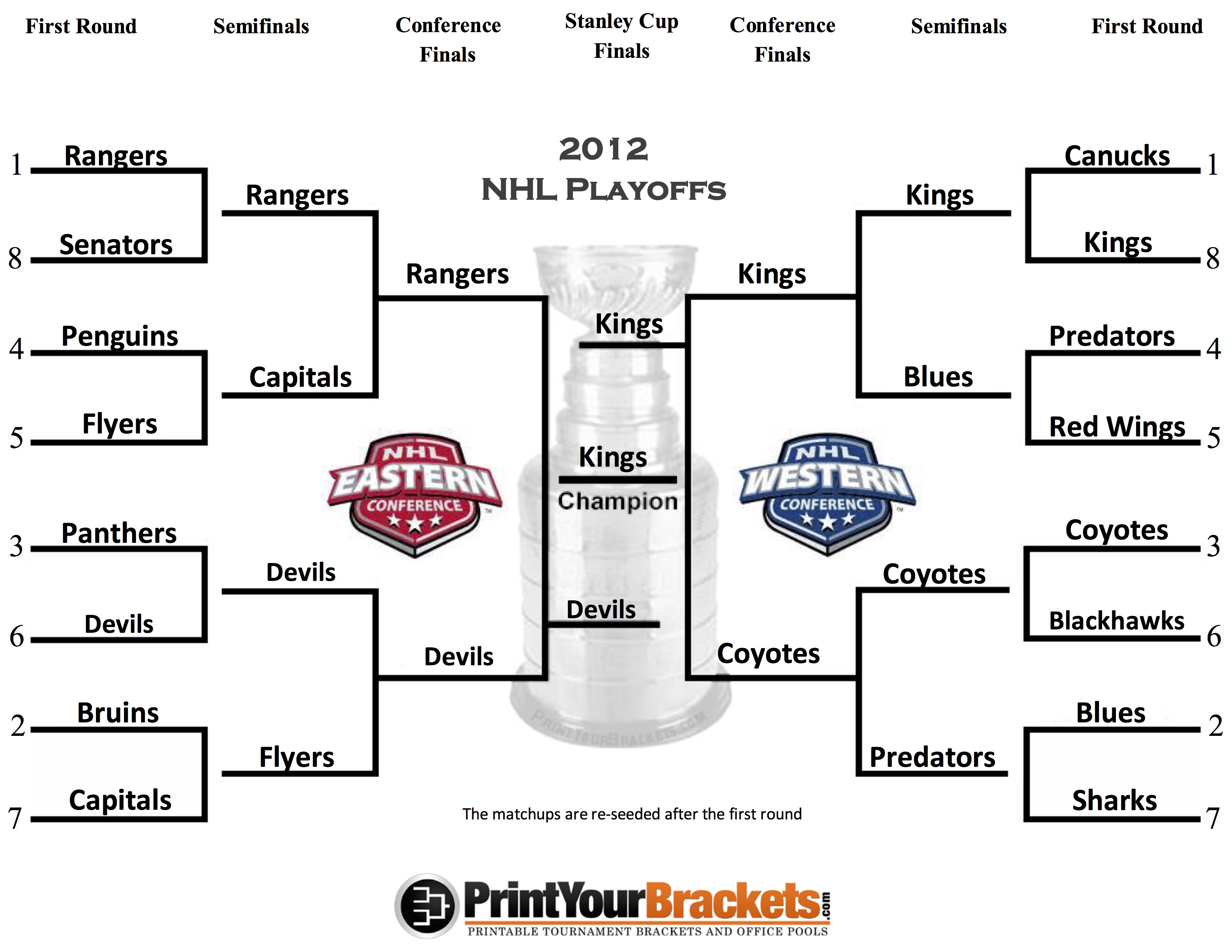
Note that the first round’s match-ups aren’t connected to the second round’s. That’s because, as I mentioned earlier, every match-up is based on the advancing teams’ seeding. If you look on the left-hand side at the Eastern Conference, you’ll see that the Capitals get past the Bruins. But because the Capitals were the 7th seed, they face the 1st seed Rangers in the next round, because the Capitals were the lowest seed to advance, and the Rangers were the highest. The Flyers, as the 5th seed, are then matched up with the 6th seed Devils.
There’s a bit more nuance to it (such as the seeding of division winners and how the team with higher seeding gets home ice advantage), but as long as you get the whole “1 vs. 8, 2 vs. 7, etc.” thing, that’s basically the gist of it.
But in 2013, the NHL needed restructuring. Some teams needed to be shuffled around and space needed to made for the upcoming additions of the Las Vegas and Seattle teams. The league decided to put more emphasis on the divisions within the conferences, particularly when it came to the playoffs. Instead of two big brackets that would be reseeded after every round, the league created four brackets, one for each division. Each division got four spots in the playoffs. Three were given to the top three teams in each division, and the fourth spot was for a “wildcard” team. The two best remaining teams in each conference would get those wildcard spots, regardless of their division.
Confused? So am I! Maybe this will help:
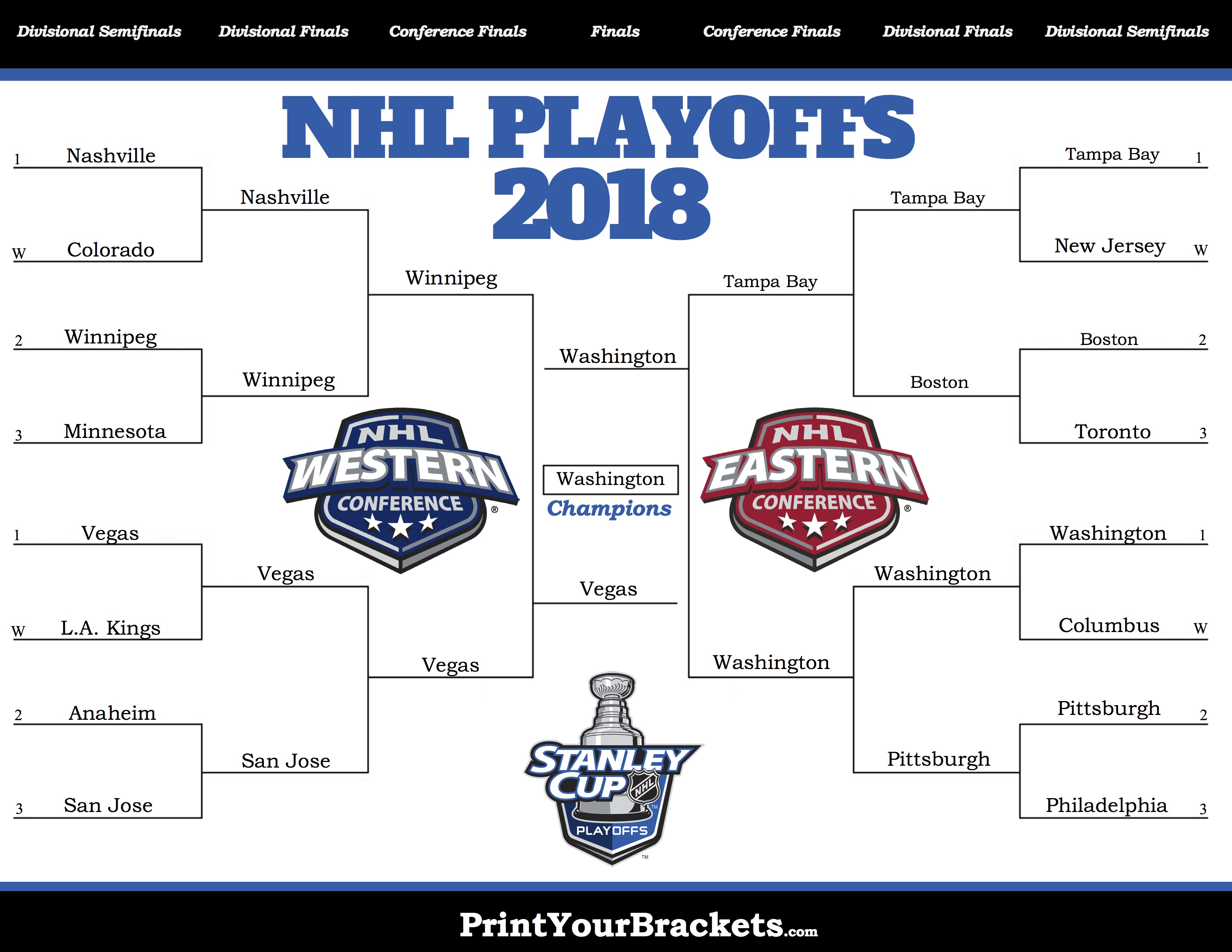
Let’s say, in this scenario, you’re the Vegas Golden Knights. You’re in the Pacific Division in the Western Conference. You now need to go through two rounds of divisional opponents (in this case, the wildcard L.A. Kings and the San Jose Sharks) before you reach the winner of the other Western Conference division (the Winnipeg Jets in the Central Division) in the third round. After that, you move on to the Finals to face the winner of the Eastern Conference (the Washington Capitals). It’s a nice, clear path from the first round to the Finals. As you can see from the bracket above, it looks a bit like March Madness.
So why are people upset about the new playoff format? From I’ve observed, it’s for a few different reasons.
The first is that if you’re used to the old format, the new one can be a bit difficult to get your head around. While this is a simplified way of seeing it, the old way was understood as “the best eight teams in each conference and the best team always goes against the worst.” The new format, with its divisional brackets and wildcard teams, is a bit more complicated. I expect, though, that once fans get used to the new emphasis on a team winning its division over its conference, understanding the format won’t be a problem anymore.
Another issue is that it can be boring to see the same teams face each other year after year. While the old format matched up teams from the same conference, the new format limits the opponents of the first two rounds to within the same division. The Toronto Maple Leafs, for example, have faced the Boston Bruins in the playoffs three years in a row, and twice in the first round. If you have two teams in a division that have consistent success, you can expect them to meet repeatedly in the playoffs. Some find this boring. Leafs fans, given that their team has lost this match-up every time, are particularly frustrated.
Yet the biggest reason to cause aggravation is that this new format seems unfair compared to the previous format. In the new format, if you’re a team in a tough division, getting through the first two rounds of the playoffs are going to be difficult. Much more difficult than if your team was in a weak division. In the First Round, the team that finishes second in its division has to play the team that finished third. Even if both teams had very good records, potentially the 2nd and 3rd best in the conference (or even the league), one team is still guaranteed to be eliminated in the First Round. But in the old format, where teams were matched up against other teams in the same conference (instead of the same division), these teams would likely be pitted against supposedly weaker opponents. For fans (and even some players), it doesn’t seem fair that a team that could be ranked second or third in the Conference should get punted out of the playoffs early just because they are in a competitive division and have to play a much more difficult opponent.
I understand these frustrations, and I don’t think these are necessarily bad reasons to dislike the new format. But despite all that, I still prefer it. So before you grab the torches and pitchforks, please just hear me out.
I’m going to be honest and admit that I sometimes find that the NHL playoffs can be a bit grueling to watch from beginning to end. We’re talking sixteen teams in a tournament made up of four rounds of best-of-seven series’ of games. That’s a lot of hockey to watch, even for a diehard fan! Sure, there’s lots of excitement for the First Round and people will tune in at the end for the Stanley Cup Finals. But if their team isn’t in it for the Second or Third Rounds, fans tend to tune out a bit.
The new format provides an added narrative to every round that helps fix this problem. In the First Round, you still have the thrill of everything kicking off and any of the sixteen teams having a chance at the Cup. With the new format, the Second Round, which used to feel a little aimless once the initial excitement began to ebb, is now about winning the division. An added bonus is that you’re usually up against a division rival. The Third Round is to win the conference against the winner of the other division and punch your ticket to the Stanley Cup Finals. And then, you finally have the last round, the big confrontation with the other conference’s winner to see who wins the cup. Every round now has an added level of excitement as a team fights towards each achievement.
And I like that there’s a higher chance of division rivals meeting in the playoffs. It helps build rivalries. Sure, some teams don’t really need it. Teams like the Leafs and Canadiens already have plenty of heated rivalries that will rage forever. But some teams need a bit of help. Teams like the Nashville Predators, the Carolina Hurricanes, and the Dallas Stars, who don’t have obvious opponents to form a rivalry with. If teams like that can face the same divisional opponent a few times in the playoffs, that can stir up the animosity between the fanbases and forge a true rivalry. And rivalries are fun, so that’s a good thing!
Of course, this year has turned everything on its head. With all four division leaders eliminated in the first round, and a wildcard team set to play in the conference finals, these arguments for and against the predictability of the playoff format have become a bit irrelevant this year. While a result this drastic is flukey, it goes to show that parity is strong in the NHL. Nothing is easy in the playoffs and nobody is safe. As long as wildcard teams are involved, we will still get the odd playoff match-ups to keep things from getting too stale.
And that, to me, shows that the format is working. The split into four divisional brackets gives the playoffs a momentum that it was missing before. And while some fans may be frustrated with their teams potentially meeting the same opponents year after year, the inclusion of wildcard teams will keep things unpredictable enough to make it interesting. I’ve enjoyed seeing this year’s playoffs develop in this new format, just as I’ve enjoyed it the past few years. I hope that after reading this, you’ll enjoy it a bit more, too.
Until, of course, the NHL changes the playoff format yet again.
 Ballcap Sports
You will find that the NHL continuously rewards weaker teams with less skill and talent with the current format. Some fans are ok with this because only a handful of teams have what it takes to win which enables the other 25 teams to remain relevant when they shouldn’t. To pretend that skill shouldn’t matter, that hacking, roughing , grabbing and physically beating your opponent in the playoffs while being clearly less skilled is entertaining or fair is beyond me. The NHL yields its regular season pointless, especially with its rather pathetic 3-point OT/SO reward system that unfairly awards a magical extra point in such games This is why MLS is surpassing the NHL now and how the NHL is turning to be nothing that a glorified Canadian game with a few good American teams.
LikeLike
Hi, Vincent. Thanks for the comment. I agree that the traditionally lax officiating in the playoffs hurts the game more than it helps, and I’ve always been annoyed that the NHL seems to be the one league that protects the less-skilled players instead of its stars.
But how is that a problem with this specific playoff format? If you’re arguing that too many teams qualify under the current system, that’s a fair position to take, but then I don’t understand your comparison to MLS, which also qualifies the top 50% of its teams for the playoffs.
LikeLike